
-
18 May 2026
- 0 Comment
Laser Cutting vs Plasma Cutting: Which Is Right for Your Project?
When it comes to metal cutting services, choosing the right process can make a real difference to the quality, cost, and turnaround time of your project. Two of the most widely used methods in modern metal fabrication are laser cutting and plasma cutting. Both are highly effective thermal cutting processes, but they work differently and suit different applications
Whether you are working on a precision-engineered component or a heavy-duty industrial and mining part, understanding how each process works will help you make the right call. This article explains how laser and plasma cutting work, the advantages and limitations of each, and how to match the right method to the specific requirements of your metal cutting project.
What is laser cutting?
Laser cutting is a non-contact thermal cutting process that uses a highly concentrated beam of light to melt, vaporise, or burn through sheet metal with exceptional accuracy. The laser beam is focused onto the material surface using computer numerical control (CNC), which guides the cutting head along a precise path to produce intricate shapes and contours.
The process works by directing a high-power laser at the material, generating enough heat to melt or vaporise it at the point of contact. A pressurised assist gas then blows the molten material clear of the cut, leaving a clean edge with minimal distortion.
At Di Candilo, we operate both fibre laser and CO2 laser cutting technology, capable of cutting materials from 0.55mm up to 25mm in thickness. Suitable materials include carbon steel, stainless steel, aluminium, and galvanised steel.
Advantages of laser cutting
Laser cutting delivers a level of precision that is difficult to match with other cutting methods. Key benefits include:
- Extremely tight tolerances make it ideal for complex or intricate designs
- Clean, smooth edges that typically require little to no secondary finishing
- High cutting speed for thin to medium thickness materials
- Lower heat-affected zones, reducing the risk of material distortion
- More energy-efficient than many alternative methods, making it a more environmentally sound option
- Cheaper day to day costs, particularly with fiber machines
Limitations of laser cutting
- Generally limited to materials up to approximately 25mm thick
- Can struggle with highly reflective metals such as copper and brass
- Higher upfront capital equipment and setup cost compared to plasma cutting
What is plasma cutting?
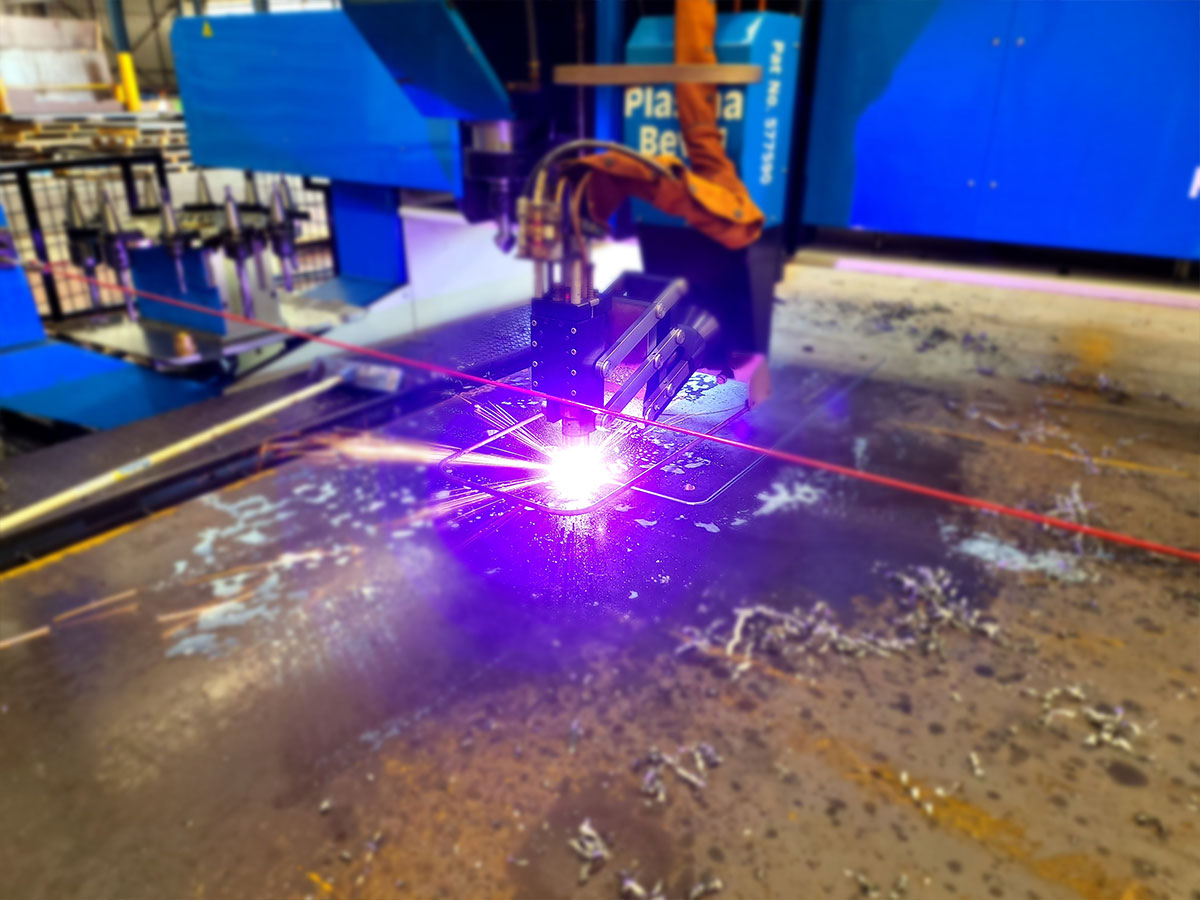
Plasma cutting is a thermal cutting process that uses a superheated, electrically ionised gas to cut at high speed through a nozzle. An electrical arc passes through the gas, converting it into plasma, which creates an electrically conductive channel capable of melting through metal at high speed. The plasma jet, combined with a stream of compressed gas, blows molten material away from the cut, cleanly separating the workpiece.
Because plasma cutting works by conducting electricity through the material, it is only suitable for electrically conductive metals. However, within that range, it is highly versatile, capable of cutting through substantial material thickness at high speed.
Our heavy-duty CNC plasma machines offer high-definition cutting with additional value-added capabilities, including drilling, tapping, countersinking, counterboring, and bevelled edges up to 45 degrees. The plasma cutting beds can accommodate components up to 9.6 metres in length and 3 metres in width.
Advantages of plasma cutting
- Capable of cutting through metals up to approximately 40-45mm thick
- Faster cutting speeds on thicker materials compared to laser
- Lower setup and equipment cost, which can translate to more competitive pricing on straightforward jobs
- Handles large-format and oversized components with ease
- Suitable for a wide range of carbon steel variants and grades including 250, 350, and Q&T hardened plate.
Limitations of plasma cutting
- Less precise than laser cutting, particularly for fine detail or tight tolerances
- Wider heat-affected zone, which can require more finishing work
- Not suitable for non-conductive materials
Key differences between laser cutting and plasma cutting
Understanding where each process excels comes down to a handful of key considerations.
Laser cutting is the choice for fine detail and clean edges. The focused beam produces a very narrow kerf (the width of the cut), allowing for highly intricate shapes with sharp internal corners. Plasma cutting, while capable of excellent results, produces a slightly wider kerf and a larger heat-affected zone, which can affect edge quality on detailed work. For example, a finely detailed component such as a saw blade or precision machinery part would require laser cutting, as plasma simply cannot replicate the level of detail required.
Plasma cutting has the advantage here. Laser cutters are generally efficient up to around 25mm in material thickness. Plasma cutters can handle metals up to approximately up to 45mm thick, and are particularly useful for components such as loader buckets, chassis rails, truck + trailer frames, mining chute liners.
For thin- to medium-thickness materials, laser cutting is generally faster. Plasma cutting tends to be quicker on thicker sections, where the laser would need to reduce its speed to maintain cut quality.
For jobs requiring high precision, intricate detail, or a clean finish with minimal secondary processing, laser cutting is typically the more cost-effective choice over the full production cycle. Plasma cutting has lower equipment costs and can be more competitive for simple, large, or thick-section cuts where absolute precision is not the primary requirement.
Laser cutting is well-suited to steel, stainless steel, aluminium, and galvanised steel. Plasma cutting works across a broader range of conductive metals, including copper, brass, and cast iron, though Di Candilo Steel City’s facility processes carbon steel, mild steel, and aluminium.
Which method should you choose?
Understanding where each process excels comes down to a handful of key considerations.
Laser cutting
Laser cutting is generally the better choice when:
- Your parts have tight tolerance specifications or intricate design details
- You need clean, smooth edges with minimal finishing
- Materials are thin to medium thickness (up to around 25mm)
- You are cutting stainless steel, aluminium, or mild steel
- Consistency across a production run is critical
Plasma cutting
Plasma cutting is generally the better choice when:
- Cutting thicker or heavy-duty metal materials for industrial applications
- Working with large or oversized fabricated steel components
- Simple shapes and standard tolerances are acceptable
- Additional processing such as drilling or bevelling is required
- Budget-friendly cutting with fast turnaround is the main priority
For construction and heavy fabrication projects, plasma cutting is often the practical choice for heavy-duty industrial, base plates, frames, and large-format wear parts. For detailed fabrication, engineering components, signage, or any work requiring close tolerances, laser cutting is usually the right tool.
It is also worth considering local availability and turnaround. Working with a Perth-based steel cutting services provider means faster lead times, direct communication, and no freight delays on your materials.
Talk to Di Candilo Steel City
Still unsure which process suits your project? Di Candilo Steel City offers both laser cutting and plasma cutting services in Perth. With over 50 years of experience in steel supply and processing, the team can advise on the right method for your material, thickness, and design requirements.
Get in touch with the Di Candilo team to discuss your project and receive a personalised quote. Call 08 9279 7244, email sales@dicandilo.com.au, or contact us online.
Custom Cutting Solutions
Our expert team in Perth is ready to deliver custom solutions that meet your exact specifications. Contact us now to discuss your needs and receive a personalised quote.