
-
27 July 2026
- 0 Comment
304 vs 316 Stainless Steel: Which One Should You Use in Perth?
If you have ever compared stainless steel options, you know the first question suppliers ask is which grade you need. In most cases, the choice comes down to Grade 304 or Grade 316. Both are strong, corrosion-resistant, and very similar in appearance. They are also stocked by almost every stainless steel supplier in Perth. However, choosing the wrong grade can lead to costly problems later on.
This guide explains what sets the two grades apart, how each performs in Perth’s coastal and inland conditions, and how to weigh up cost against durability for your project.
Quick answer: Grade 304 is the economical, general-purpose choice for indoor and inland use. Grade 316 — often called “marine grade” — costs more but resists chloride corrosion, making it the right call anywhere near the coast, a pool, or aggressive chemicals. The rest of this guide breaks down why, and how to decide for your specific site.
What is stainless steel?
Stainless steel is a steel alloy that contains at least 10.5% chromium. The chromium reacts with oxygen in the air to form a thin, invisible layer on the surface of the metal. This layer, known as the passive layer, is what stops the steel from rusting.
Other alloying elements, such as nickel and molybdenum, may be added alongside chromium to adjust properties such as strength, formability, and corrosion resistance in particular environments.
What is the difference between 304 and 316 stainless steel?
Both 304 and 316 are known as austenitic steel, meaning they are easy to form, weld, and clean, and both are used across commercial, industrial, and architectural work. The difference is composition.
| Grade 304 | Grade 316 | |
|---|---|---|
| Composition | ~18% chromium, ~8% nickel | 16–18% chromium, 10–14% nickel, 2–3% molybdenum |
| Best for | Indoor and general outdoor use | Coastal, marine, chemical and chlorine-exposed environments |
| Corrosion resistance | Good | Superior, as molybdenum resists chloride and salt attack |
| Relative cost | Lower | Higher |
| Common name | Standard/food-grade stainless | Marine-grade stainless |
Grade 304 stainless steel
Typically shows up in kitchen sinks, benchtops and splashbacks, food and beverage equipment, internal handrails and trims, machinery parts, and general fabrication. For most indoor Perth projects, it’s the practical balance of cost, appearance, and performance.
Grade 316 stainless steel
Grade 316 stainless steel’s added molybdenum significantly improves resistance to chlorides — the salt in sea spray and coastal air. That’s why it’s specified for boat fittings, coastal balustrades and railings, dock and waterfront hardware, chemical and process equipment, and any component regularly hit with chlorine-based cleaners.
At Di Candilo, we stock both 304 and 316 grades of stainless steel in a full range of sheet sizes and thicknesses. As a trusted stainless steel supplier in Perth, we also help you work out which one fits your project before you commit to the material.
Why does corrosion resistance matter in coastal areas?
Perth, being a major coastal city, has an atmosphere that creates demanding conditions for exposed metal. Airborne salt can settle on stainless steel surfaces, particularly near the ocean or in sheltered areas where deposits are not regularly washed away.
Grade 304 can perform well outdoors, but repeated or unchecked chloride exposure increases the risk of pitting, tea staining and localised corrosion. The molybdenum in Grade 316 gives it better resistance to this type of attack.
As a general thumb rule, here’s when to choose 304 and when to choose 316:
- Within a few kilometres of the ocean, or anywhere exposed to direct sea spray, choose 316 stainless steel.
- Around swimming pools, 316 stainless steel is a safer option.
- Further inland, in suburbs away from the coast and in most indoor settings, 304 stainless steel performs very well and is the more economical choice.
Practical tip:
Whether it’s 304 or 316 grade stainless steel, regular cleaning helps either grade because stainless steel is corrosion-resistant, not maintenance-free.
Common applications for each grade
Choosing the right stainless steel grade depends on how and where it will be used, especially the level of exposure to moisture, salt and chemicals.
Food and beverage
Grade 304 is widely used for food preparation surfaces, sinks, storage tanks and general processing equipment because it is easy to clean and performs well in many hygienic environments.
Grade 316 may be better where equipment encounters salt, acidic ingredients, aggressive cleaning products or demanding processing conditions.
Marine and coastal projects
For boat fittings, waterfront structures, coastal railings and exposed external components, 316 is usually preferred. Its improved chloride resistance can reduce staining, pitting and premature replacement.
Construction and manufacturing
Grade 304 suits many internal architectural elements, appliances, machinery components and general fabrication.
Grade 316 is better suited to external coastal installations, chemical environments and parts where corrosion would create costly maintenance or operational problems.
Some projects require fine contours, clean edges and tight tolerances; at that time, processing the chosen stainless steel through laser cutting becomes essential.
Which stainless steel finish should you choose?
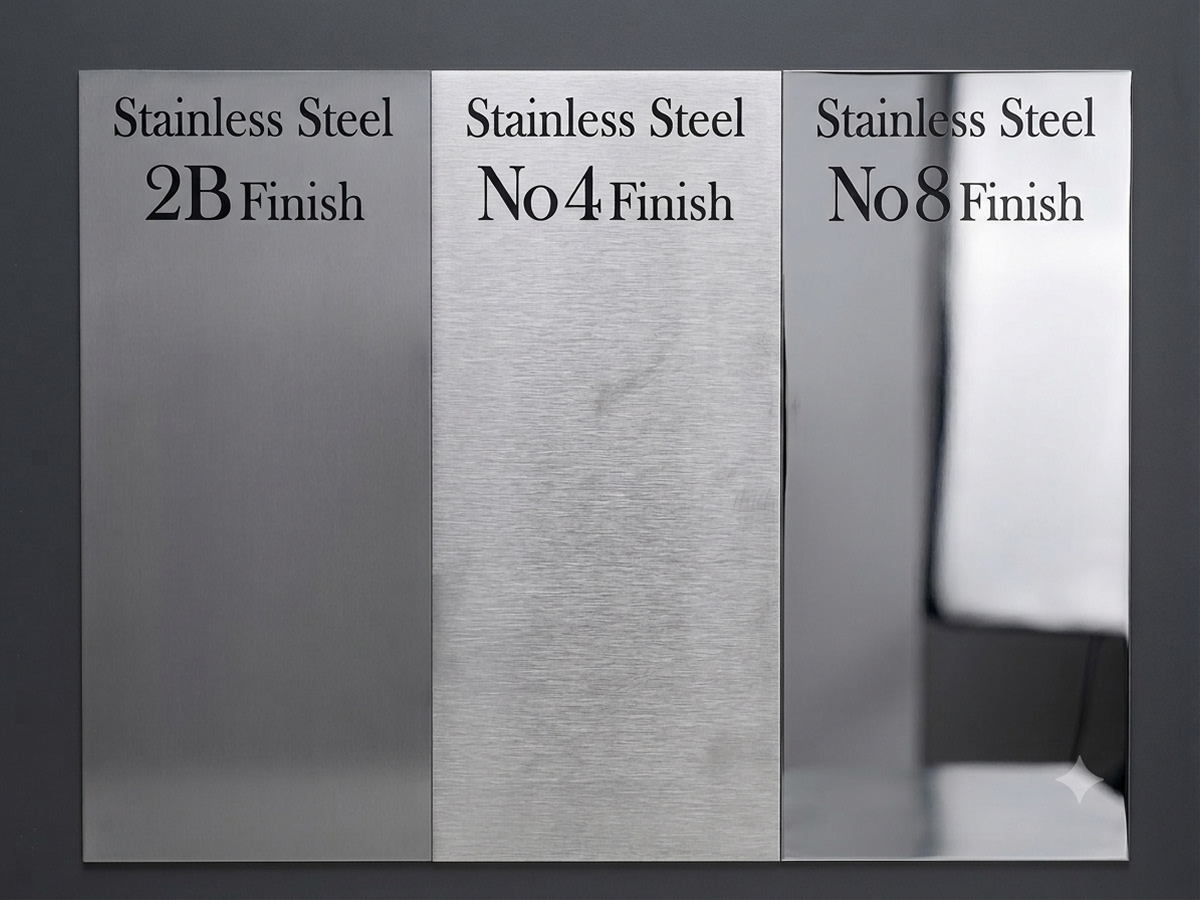
Grade determines how the steel performs, and finish determines how it looks. The most common surface finishes on stainless steel products are:
- 2B – a smooth, dull grey mill finish. This is the standard general-purpose option and the most economical.
- No.4 (brushed or satin) – a fine linear grain with a soft sheen. Popular for kitchens, lift interiors, and architectural work because it hides fingerprints and light scratches well.
- No.8 (mirror) – a highly polished, reflective finish used for decorative and high-end architectural features.
- No.1 – a matte, hot-rolled finish used for industrial plates where appearance is not a priority.
Di Candilo supplies 304 and 316 stainless steel products in finishes including 2B, No.4 brushed and No.8 polished or ultra-polished. The smoother the finish, the better the corrosion resistance because salt and grime are less likely to accumulate on the surface.
Additionally, if your stainless steel products need branding or identification, our laser etching and engraving can add permanent logos, serial numbers, labels and decorative details with precision.
Cost vs durability: making the call
316 typically costs more than 304, and on a large requirement, that difference adds up. So, is it worth it to spend an additional amount?
The honest answer is: only when the environment demands it. For example, using 316 for an indoor commercial kitchen in Midland is money spent on corrosion resistance you will never use. Using 304 for a balustrade in Cottesloe is a false investment, because the cost of replacing tea-stained steel will quickly outweigh the saving on material.
A simple way to decide which grade to use:
- Map the environment: How close is the project to the ocean? Is there pool water, chemical exposure, or industrial fallout nearby?
- Consider access for maintenance: Surfaces that are easy to wash down can tolerate 304 in milder coastal zones. Hard-to-reach surfaces near salt should be 316.
- Think in lifetime cost, not just purchase price: For a part expected to last 25 years outdoors near the coast, the upfront cost of 316 is small compared with the cost of early replacement.
If you are unsure about which grade to choose, an experienced stainless steel supplier like Di Candilo Steel City can help you choose a suitable stainless steel grade that suits your site.
Find the right stainless steel grade for your project
Choosing between 304 and 316 stainless steel comes down to the conditions your material will face. Grade 304 is a practical choice for many indoor and general-purpose applications, while grade 316 offers better protection in coastal, marine and chloride-rich environments.
Di Candilo supplies both grades across a wide range of stainless steel products and can help you select the right option based on your application, finish, environment and budget.
Contact our team online, call us at 08 9279 7244, or send an email to sales@dicandilo.com.au to discuss your requirements and request a personalised quote.
Custom Cutting Solutions
Our expert team in Perth is ready to deliver custom solutions that meet your exact specifications. Contact us now to discuss your needs and receive a personalised quote.